Journées thématiques de la FAERE

16th Thematic Workshop of the French Association of Environmental and Resource Economists
1 & december 2026

TOWARDS A LOW DEMAND ECONOMY POLICIES, TRANSFORMATION PATHWAYS, MACROECONOMIC RECONFIGURATIONS AND HIGH WELL-BEING WITHIN PLANETARY BOUNDARIES

Please visit directly the website for more information: https://jtfaere2026.org/.

International conference organized by the CIRED and the LoDEEP research group with the support of the Chair Prospective Modeling for Sustainable Development, the SPECULAR Project – PEPR SPLEEN, the ANR-funded Be·Aware project, the FAEREand AgroParisTech.

Motivation and objectives

Dominant approaches to climate mitigation continue to assume high levels of energy and material demand – a tendency reflected in most transition scenarios, which rely on large-scale technological fixes whose feasibility is increasingly questioned. Shifting the analytical and policy focus towards demand reduction – through efficiency improvements, sufficiency-oriented policies, and structural changes in production and consumption patterns – is now a necessary step for viable socio-economic trajectories compatible with planetary boundaries.

Lower demand levels offer key advantages: they can expand the feasible space for rapid energy system decarbonization, alleviate material and biophysical constraints, and strengthen macroeconomic resilience by reducing exposure to volatile resource imports and investment bottlenecks. Yet, systemic demand reduction raises fundamental questions that remain insufficiently addressed across research communities: What policy frameworks can trigger the structural changes in practices required? What industrial and sectoral reconfigurations are compatible with – or necessary for – low demand transitions? What are the macroeconomic and structural implications of systemic changes in production and consumption patterns; of post-growth policies? How can these transitions support well-being, guarantee social equity, and ensure decent living standards for all?

This conference aims to bring together different strands of research addressing these questions, to advance a shared understanding of what a transition towards a low demand and high well-being economy could look like. We seek to convene an interdisciplinary group of international researchers working across energy and integrated assessment modeling, industrial ecology, ecological and environmental economics, ecological macroeconomics, and political and social sciences.

We welcome theoretical and applied contributions addressing the following themes:

Sufficiency and efficiency (energy, material) policies: policy instruments and evaluation, rebound effects, preferences and conditions for behavioral changes, including the role of the perception and communication of environmental impacts;

Low demand pathways: integrated transformation pathways, supply-demand interactions, material and biophysical constraints, energy transition dynamics, net energy analysis, stock-flow analysis;

Macroeconomic and industrial reconfigurations: structural change and employment impacts, growth dynamics, sectoral transitions, industrial policy, quantity-quality transitions, circular economy, post-growth transitions;

Equity, well-being and decent living: distributional impacts, well-being frameworks and co-benefits (including health), decent living standards, consumption corridors.

This list is not exclusive, and we strongly encourage the submission of contributions dealing broadly with the proposed topics.

Invited speakers

–          Milena Büchs (University of Leeds)

–          Simone D’Alessandro (University of Pisa)

–          Aude Pommeret (University Savoie Mont Blanc)

–          Frauke Wiese (University of Flensburg)


More information here.

Scientific Committee

Scientific Committee:

Julien Lefèvre (CIRED-AgroParisTech), Thomas Le Gallic (CIRED-ENPC), Mathilde Arnaud (CIRED-ENPC), Clotilde Chagny (i-tésé-CEA), Victor Court (IFPEN), Pascal da Costa (LGI-CentraleSupélec), Vivien Fisch-Romito (Uni. Lausanne), Céline Guivarch (CIRED-ENPC), Fanny Henriet (AMSE-CNRS), Florian Leblanc (CIRED-CNRS), Claire Le Renard (LATTS-ENPC), Nadia Maïzi (CMA-Mines Paris-PSL), Alexandre Mallard (CSI-Mines Paris-PSL), Vincent Martinet (PSAE-INRAE), Alma Monserand (ADEME), Julia Péré (CIRED-CNRS), Mathieu Pierronne (CIRED-ENPC), Francesco Ricci (CEE-M & FAERE), Kilian Rouge (CIRED-AgroParisTech), Yamina Saheb (World Sufficiency Lab & Sciences Po), Nicolas Taillard (négaWatt), Bas van Ruijven (IIASA)

Local Organizing Committee:

Julien Lefèvre (CIRED-AgroParisTech), Thomas Le Gallic (CIRED-ENPC), Mathilde Arnaud (CIRED-ENPC), Céline Guivarch (CIRED-ENPC), Florian Leblanc (CIRED-CNRS), Julia Péré (CIRED-CNRS), Mathieu Pierronne (CIRED-ENPC), Kilian Rouge (CIRED-AgroParisTech)

Submission of papers

We welcome papers of any length and extended abstracts (roughly 1000-8000 words as a guide). Papers / extended abstracts must be in English and must include a cover page with the following information:

– short abstract of up to 200 words, and maximum 5 keywords

– authors’ full name and affiliation

– contact details for the corresponding author


Papers / extended abstracts should be submitted here. The submission form includes an “abstract” field where you can paste your short abstract. Your paper / extended abstract, including the cover page, must be uploaded via the form (step 3).


The contributions selected by the scientific committee will be presented in English and exclusively on-site, remote presentations are therefore excluded.

Please note that we will not be able to cover accommodation or travel expenses for presenters of accepted papers. Registration and participation will be free of charge.

Key deadlines

Submission : September 13th
Acceptance : October 4th
Registration : October 25th

Publication opportunities

Opportunities for further dissemination and valorisation of selected contributions are currently being explored and will be discussed with the authors of accepted submissions.
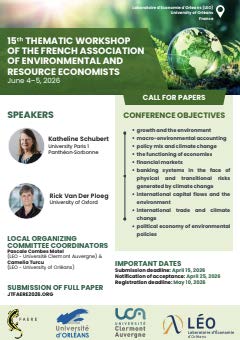
 

On November 28th and 29th (2024), the CEPN will organize the 14th Journées Thématiques of FAERE (French Association of Environmental and Resource Economists) at Campus Condorcet (Auditorium, centre des Colloques). The selected theme of the two-day international conference is « Environment, Policies, and Risks: Heterogeneities in Climate Change and Sustainability » and we particularly encourage submissions dealing with the following topics

– New dimensions and diversity of climate-related risks, financial markets- Heterogeneous effects on labour markets, inequality, just transitions
– Climate change and technological innovations
– Firms’ and consumers’ strategies, energy choices
– Heterogeneous environmental policies, political economy

Important dates
Submission deadline:                       September 10th
Acceptance:                                      September 27th
Registration (paper presenters):    October 18th

You will find the Call for papers attached to this email, and you can also visit the website of the conference for further details, submissions and registration at 

https://jt-faere-epr24.sciencesconf.org/

The keynote speakers at the conference will be

* Mireille Chiroleu-Assouline (Paris School of Economics)
* Stefano Giglio (Yale University) (remotely)
* Francesco Quatraro (University of Turin)
* Richard Tol (University of Sussex)
* Francesco Vona (University of Milan and FEEM)

The event is organized with the support of FAERE, the University Sorbonne Paris Nord, and the Fondation pour la modélisation en économie (Labex MME-DDI). It is also sponsored by the INFER network, the Energy & Prosperity Chair and Climate Economics Chair.

We hope that many of you will get involved by circulating the call and related information, submitting your research work, and participating in the conference.

Best regards,

Donatella Gatti, Imen Ghattassi, Gaye-Del Lo, Malo Mofakhami, Sandra Rigot, Julien Vauday

JT FAERE EPR_2024 CEPN

Call_Doctoral_Workshop_FAERE_24

FAERE and Solar Academy are pleased to announce the launch of the third edition of the doctoral workshop, which will be held in Annecy on 14 and 15 March 2024.

Doctoral students working in environmental, natural resources and energy economics are invited to present their papers, research projects or thesis chapters.

All contributions are welcome. The workshop will host both theoretical and empirical works, at different stages of development. The objective is to open a space for academic and friendly discussion, to bring together the community of PhD students in our field, to allow them to present their work in progress, to test a research idea, to share their experiences, or to submit

research difficulties to their peers in order to find solutions.

The program will consist of 30 minutes of presentations, in English or French, followed by a short discussion by a PhD student and a senior researcher.

If you wish to participate, please submit a long abstract (1000 words maximum), by 22 January 2024 to the following address:

Selected students must be up to date with their FAERE membership at the time of the workshop. Mission expenses will be covered.

Important dates:

Submission: 22 January 2024

Notification of acceptance: 12 February 2024

Les 13èmes Journées thématiques FAERE se tiendront à l’Université Gustave Eiffel (Cité Descartes, Champs-sur-Marne), les 1er et 2 juin 2023, sur le thème « Villes et Environnement ».

Appel à communications
Date limite de soumission : 19 avril 2023
Notification d’acceptation : 5 mai 2023
Date limite d’inscription : 19 mai 2023

Site web de la conférence : https://jt-faere23.sciencesconf.org/

Les 12èmes Journées thématiques FAERE se tiendront à l’Université Paris-Saclay, les 21 et 22 avril 2022, sur le thème « Économie et gestion du changement climatique : lier adaptation et atténuation ».

Cet atelier de deux jours comprendra :

  • Une conférence du Pr. Thomas Sterner (Université de Göteborg)
  • Des sessions de présentation d’articles de recherche sélectionnés en économie et gestion
  • Une table ronde avec des scientifiques, des décideurs politiques et des parties prenantes, pour discuter des conclusions du sixième rapport d’évaluation (RE6) du GIEC sur « Impacts, Adaptation et Vulnérabilité » (groupe de travail 2) et « Mitigation du changement climatique » (groupe de travail 3) qui seront rendues publiques quelques semaines avant l’atelier.

Lien vers l’inscription en ligne : https://forms.gle/4VkMjtfescaYuhem9

Programme (en anglais)

Site de la conférence

Les 11èmes journées thématiques de la FAERE ont eu lieu à l’Ecole d’Economie de Paris, en France, les 9 et 10 décembre 2019. Sur le thème de la transition énergétique, divers sujets ont été traités dont l’utilisation des combustibles fossiles, les énergies renouvelables, l’efficacité énergétique, l’innovation et les instruments de la transition énergétique.

Programme

Les 10èmes Journées thématiques de la FAERE, organisées par l’Université de Guyane, ont été consacrées à trois sujets complémentaires « Energie – Biodiversité – Transition écologique ».

Le programme était composé de présentations orales, sélectionnées par le comité scientifique.

Les trois présentations invitées ont été assurées par :

– Stefan Baumgärtner (Allemagne),
– Quentin Grafton (Australie),
– Michel Loreau (France).

Site de la conférence

Les trois présentations invitées ont été assurées par :

– Pascal Boireau (Directeur du laboratoire de Santé animale, ANSES, France),
– Olivier Deschenes (Professeur à l’Université de Californie, Santa Barbara, EU),
– Nicolas Treich (Directeur de Recherche à l’INRA, TSE-R, France).

Les informations du workshop à jour sont disponibles à cette adresse : http://www.lov.obs-vlfr.fr/
Programme : Call_FAERE_Villefranche_Nov_2015
Inscriptions libres dans la limite des places disponibles :
http://mesi.obs-vlfr.fr/workshop/Registration

Appel à communications : Appel JTFAERE 2015
Programme : Programme JT FAERE 2015
Contact : Dorothée Brécard (brecard(at)univ-tln.fr)

Consacrées aux problématiques dynamiques et/ou spatiales inhérentes aux questions environnementales et de gestion des ressources naturelleses, ces journées thématiques ont été organisées conjointement par l’Université Paris Ouest Nanterre la Défense-EconomiX, l’INRA-AgroParisTech et la FAERE.

Programme

Contact : Natacha Raffin (nraffin(at)u-paris10.fr) et Vincent Martinet (vincent.martinet(at)grignon.inra.fr)